


Introduction
Let’s be honest—how often have you caught yourself typing “according to…” repeatedly in an essay or report? Sure, it’s a classic phrase, but it can get tired fast. Whether you’re writing an article, academic paper, or just trying to sound less repetitive, switching it up makes your writing sharper and way more engaging. From formal substitutions to casual alternatives, we’ve rounded up 30 ways to say “according to” without sounding like a broken record. Ready to freshen up your phrasing and sound a bit more polished? Let’s get into it.
“According To” Meaning
The phrase “according to” is one of those quietly powerful tools in English. It simply means as stated by or as reported by someone or something.
- “According to” + source = someone else’s view, info, or rules.
Examples:
- “According to the weather forecast, it’s going to rain tomorrow.”
- (The forecast says it’ll rain—not necessarily a fact, just what the forecast predicts.)
- “According to my doctor, I need to cut back on sugar.”
- (That’s your doctor’s professional opinion.)
- “According to the rules, phones aren’t allowed in class.”
- (The rules dictate this, not necessarily the speaker’s personal opinion.)
A little nuance:
Using “according to” is a polite way to share information while distancing yourself from it. You’re not saying you believe it—it’s just what someone else said. Kinda like, “Don’t shoot the messenger!”
Also, it’s super common in journalism, research, or even gossip:
- “According to recent studies…” (Science talk.)
- “According to Lisa, Mark never replied.” (Tea spill.)
When to use “According To”
“According to” is one of those handy little phrases that can sound perfectly natural—or off—depending on how you use it. It’s mainly used when reporting information, ideas, or opinions from someone else. Think of it as your way of saying, “Hey, don’t shoot the messenger!”
Here’s when it makes sense to use it:
✅ When You’re Referencing a Source or Authority
This is the most common and correct use.
- Factual or research-based claims:
- → “According to the CDC, flu season peaks between December and February.”
- Quoting someone else’s opinion (especially when it’s not your own):
- → “According to my brother, pineapple belongs on pizza.”
- News, reports, data:
- → “According to the latest Nielsen ratings, the show lost a third of its audience.”
✅ When You Want to Distance Yourself From the Statement
Sometimes, you don’t want to commit to something—you just want to say someone else said it.
- → “According to some analysts, the stock market’s heading for a downturn.”
- (Notice the wiggle room there? You’re not saying you agree, just that someone out there does.)
❌ When You’re Stating Your Own Belief or Fact
Here’s where people trip up. You don’t use “according to” for your thoughts or universal truths.
- Wrong: “According to me, this is the best pizza place.”
- Right: “I think this is the best pizza place.”
- Also, don’t use it with stuff that’s common knowledge unless you’re being ironic.
Why to say “According To”
aying “according to” is a simple way to attribute information or opinions to a source—whether that’s a person, a study, an organization, or even common belief. It’s like pointing to someone and saying, “Hey, this isn’t me saying this—this is them.” Handy, right?
Why we use “according to”:
- Cite the source – It helps you show where your info came from. This is especially important in research, journalism, or anything that deals with facts or credibility.
- According to the CDC, flu season peaks between December and February.
- Distance yourself from the opinion – Sometimes we’re quoting something we don’t necessarily agree with, so “according to” adds that little bit of professional distance.
- According to critics, the film was a disaster. (But maybe you secretly loved it.)
- Keep it objective – It’s a way to report facts or opinions without inserting bias or turning it into hearsay.
- According to market analysts, inflation is expected to slow down.
Alternatives (because “according to” can get repetitive):
- As stated by…
- Per [source]…
- [Source] reports that…
- In the words of… (a bit more literary)
- Based on [source]… (when you’re summarizing)
But “according to” is pretty neutral, transparent, and safe in most situations—like the plain bagel of attribution. Boring? Maybe. Reliable? Absolutely.
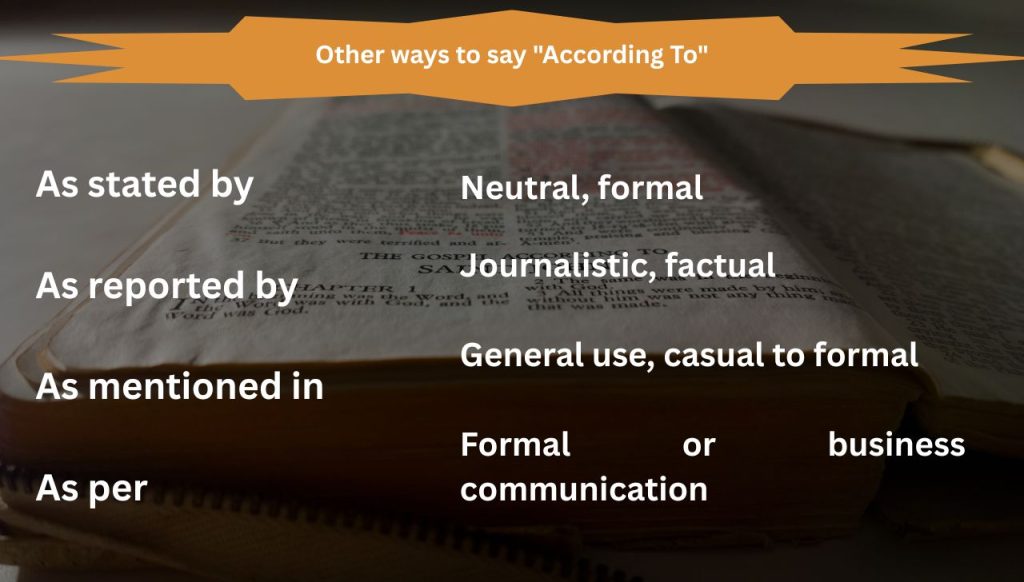
Other ways to say “According To”
| Alternative Phrase | Context / Notes |
|---|---|
| As stated by | Neutral, formal |
| As reported by | Journalistic, factual |
| As mentioned in | General use, casual to formal |
| As per | Formal or business communication |
| Cited by | Academic or legal |
| Based on | Common, analytical tone |
| As noted by | Professional or academic tone |
| In the words of | Quoting directly, often literary or emotional |
| As detailed by | Technical or instructional |
| In the opinion of | Subjective or evaluative sources |
| As outlined by | Instructional or structured writing |
| As revealed by | Media or news-oriented |
| In line with | Formal, often in policy or alignment contexts |
| As claimed by | Neutral or skeptical, depending on tone |
| According to the account of | Historical or narrative usage |
| As highlighted by | Analytical or promotional |
| From the perspective of | Subjective, thoughtful |
| As described by | Neutral, descriptive |
| Referencing | Academic or professional |
| Per | Very formal, often legal or contractual |
| In the view of | Subjective or philosophical |
| Reportedly | Neutral, common in journalism |
| As indicated by | Analytical, data-driven contexts |
| As referenced by | Academic or technical writing |
| As relayed by | Conversational or narrative tone |
| Quoting | Simple, direct quoting |
| Testified by | Legal or investigative contexts |
| In accordance with | Legal, regulatory, or formal writing |
| Backed by | Data-driven or support-based claims |
| From what [source] says | Conversational, informal tone |
Conclusion
So there you have it—30 solid ways to replace “according to” without losing clarity or tone. Whether writing for work, school, or just brushing up your skills, these alternatives keep things fluid and enjoyable. Remember, variety in expression isn’t just about sounding smart—it’s about keeping your reader tuned in. Mix and match these phrases depending on the vibe, and your writing will thank you.

Grammar Nerd, ESL Trainer, Low-Key Comma Crusader
Daniel has taught English for over a decade, from small community classes in Oaxaca to bustling university halls in London. He has a knack for turning even the driest grammar points into relatable, real-life language tools—think fewer red pens, more real talk. He co-founded Grammation to make grammar less gatekeeper-y and more global. When he’s not decoding sentence structures, he’s probably hiking with a paperback novel or adding unnecessary hyphens for fun.
“The rules of grammar should empower people—not trip them up.”