


Ever stumbled upon the phrase “for your reference” and wondered if there’s a fresher or more fitting way to say it? You’re not alone. It constantly pops up in emails, documents, and workplace chats. But sometimes, it sounds a bit too formal or robotic, especially when trying to keep things friendly or natural. Whether you’re writing to your boss, a client, or a coworker, there’s a better phrase just waiting to be used.
What Does “For Your Reference” Mean?
The phrase “for your reference” is a polite way to say, “Here’s something you might want to look at” or “I’m sharing this so you have the information if you need it.” It’s often used in emails, reports, or documents when someone includes additional details, attachments, or links that aren’t urgent but could be helpful. Think of it like saying, “Hey, this isn’t required reading, but it might come in handy.”
Let’s break it down:
✅ Common meanings:
- To provide background info:
- “Attached is the budget from last quarter, for your reference.”
- → You’re not being asked to act on it—just to have it available.
- To support something already mentioned:
- “Here’s the client’s original request, for your reference.”
- → This helps someone understand the context of a current conversation.
✅ It’s polite and low-pressure:
It’s a nice way to avoid sounding bossy. You’re not saying, “Read this now!”—you’re saying, “Here’s something to keep in mind if you’re interested.”
Where You’ll See It Used:
- In work emails:
- “For your reference, I’ve included the project timeline below.”
- When sharing documents or links:
- “For your reference, here’s the article I mentioned.”
- During training or handovers:
- “This checklist is for your reference if you get stuck.”
Common Situations Where “For Your Reference” Is Used
The phrase “for your reference” is like that trusty paperclip in your mental stationery drawer—it’s tidy, helpful, and shows up in all kinds of professional (and even casual) contexts. People use it to share information that may not require a reply but could be helpful down the line. Here are some everyday situations where this phrase pops up:
Following Up After a Meeting
Let’s say you just wrapped up a Zoom call with a vendor. A follow-up email might include the meeting notes or a summary—yep, you guessed it—for your reference.
“Here’s a summary of our discussion and the action items for your reference.”
It’s polite and shows they’re organized without sounding too pushy.
Providing Background Info
You might drop this phrase alongside past communications or context when onboarding a new team member or looping someone into a project.
“I’m forwarding the previous conversation thread for your reference.”
It’s code for: Catch up when you have time. No rush.
Legal or Policy Documents
HR folks and compliance teams love this one. Anytime they drop a PDF about procedures or company rules, you can bet it ends with “for your reference.”
“Please see the updated policy on remote work attached, for your reference.”
It signals, “We told you,” while staying friendly.
Client Communication
Freelancers, agencies, and consultants often use it when sending estimates, drafts, or past work samples.
“Here’s a breakdown of the project timeline for your reference.”
It’s professional, non-invasive, and gives the client something to chew on without demanding an immediate reply.
Why to say “for your reference meaning”
Using the phrase “for your reference” in emails and messages can be helpful when you want to share information someone might need now or later—but there’s a right (and less stiff) way to do it.
Let’s break down how and when to use it, plus a few alternatives that might feel more natural, depending on the tone you’re going for.
✅ What “For Your Reference” Actually Means
At its core, “for your reference” just means:
“I’m sharing this in case you want or need to refer to it later.”
It’s often used when attaching files, forwarding previous messages, or pointing to specific resources, like:
- A past invoice
- Meeting notes
- Project guidelines
- A link to a document or article
But here’s the catch: while it sounds professional, it can also come off as overly formal or a little cold in casual settings.
📧 When to Use It (with Examples)
1. Sharing background info
If someone’s jumping into a project or conversation late, you can bring them up to speed:
Hi Sarah,
For your reference, I’ve attached the original project brief from March. Let me know if you have any questions.
2. Providing documentation or proof
When you’re sending something like a receipt, contract, or a previous thread:
Hey John,
Here’s the signed agreement, for your reference.
3. Forwarding emails or past messages
Maybe someone asked you about a past conversation or request:
Just forwarding the email from last week, for your reference.
🙃 When It Sounds a Bit Too Formal
If you’re emailing a coworker, teammate, or someone you chat with regularly, “for your reference” might feel stiff. It’s perfectly fine in a formal setting, but day-to-day? You’ve got smoother options.
💬 Friendlier Alternatives
Sometimes you want the same idea without sounding like you’re writing from a legal department. Here are a few softer alternatives:
- “Just so you have it”
- Attached the slides—just so you have it handy.
- “In case it’s helpful”
- Here’s the template, in case it’s helpful.
- “Thought you might want this”
- Thought you might want this chart from last week’s report.
- “Here’s a copy of…”
- Here’s a copy of the meeting agenda for your review.
- “FYI”
- FYI, the updated contract is attached.
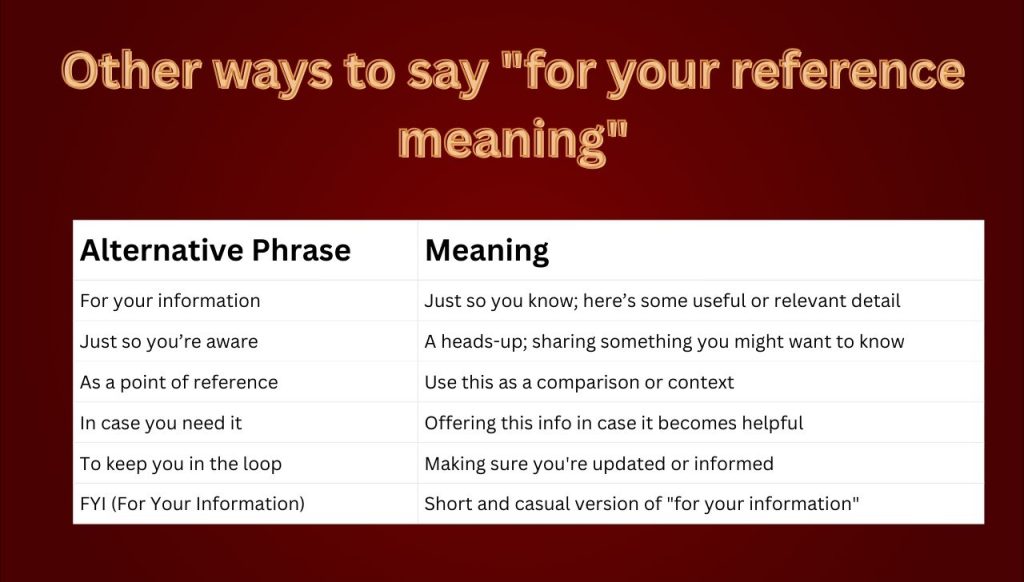
Other ways to say “for your reference meaning”
Sure! Here’s a table with 30 alternative ways to say “for your reference”, along with their meanings. Each phrase can be used to share information, documents, or details that might be helpful or useful to someone.
| Alternative Phrase | Meaning |
|---|---|
| For your information | Just so you know; here’s some useful or relevant detail |
| Just so you’re aware | A heads-up; sharing something you might want to know |
| As a point of reference | Use this as a comparison or context |
| In case you need it | Offering this info in case it becomes helpful |
| To keep you in the loop | Making sure you’re updated or informed |
| FYI (For Your Information) | Short and casual version of “for your information” |
| For your review | Please take a look at this; may need your feedback |
| For your consideration | Think about this; may be relevant to your decision |
| For your records | Keep this on file or save it for future use |
| For your perusal | Formal way of saying “please review this” |
| For your awareness | Just to make you aware of this issue or detail |
| Should you need it | Sharing something that may come in handy |
| In case it’s helpful | Offering this in case it helps you |
| In case it comes up | Sharing it so you’re prepared if the topic arises |
| Just putting this here | Informal way to share info, no immediate action required |
| For context | Background info to help you understand something |
| For your understanding | So you can better grasp or follow the situation |
| If it’s of any use | In case this info serves a purpose for you |
| For comparison purposes | Use this to compare with another document or case |
| So you’re informed | Making sure you have the necessary info |
| For future reference | You don’t need it now, but you might later |
| To give you a heads-up | Warning or alerting you in advance |
| For documentation | Adding this for proper record-keeping |
| Just adding this here | Sharing casually without any demand or urgency |
| For tracking | To help you monitor or follow progress/details |
| So you can follow along | Making sure you’re on the same page (informally) |
| For better understanding | Aiming to clarify something |
| For clarity | To prevent confusion |
| As background info | Extra details to support what’s being said or done |
| Attached for your use | A polite way to say “here’s something that might help” |
Conclusion
Language doesn’t have to be stiff to sound professional. Swapping out “for your reference” with something more natural can change how your message feels—more human, more helpful. From casual to formal, there’s a phrase for every vibe. Try a few out and see how they fit your communication style. After all, the right words don’t just inform—they connect. And that’s what makes your message stick.

Grammar Nerd, ESL Trainer, Low-Key Comma Crusader
Daniel has taught English for over a decade, from small community classes in Oaxaca to bustling university halls in London. He has a knack for turning even the driest grammar points into relatable, real-life language tools—think fewer red pens, more real talk. He co-founded Grammation to make grammar less gatekeeper-y and more global. When he’s not decoding sentence structures, he’s probably hiking with a paperback novel or adding unnecessary hyphens for fun.
“The rules of grammar should empower people—not trip them up.”